Visit 5 - 9th August 2019
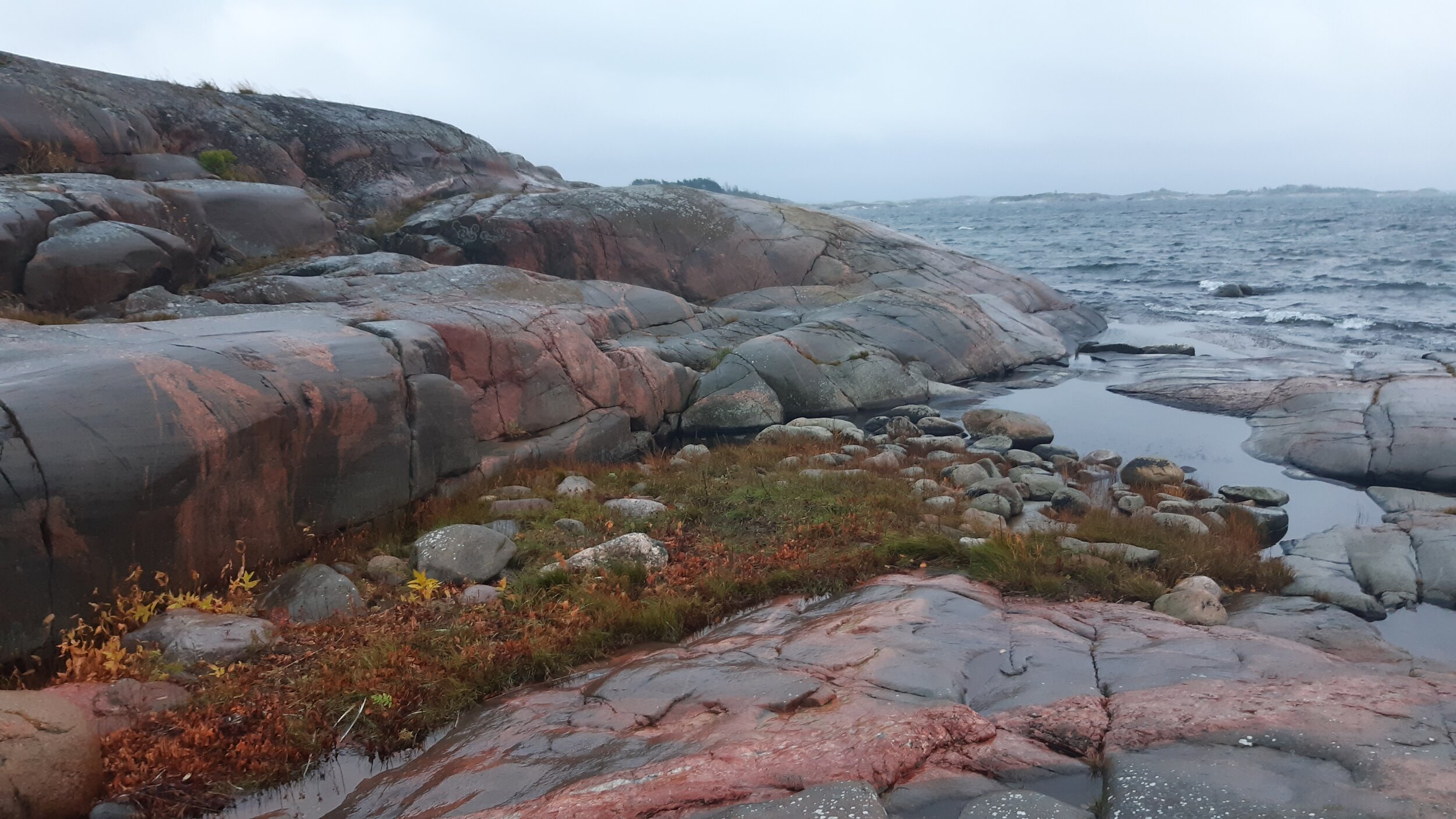
I visited Seili by taking a small commercial commuter boat from Turku, the journey two hours. The sun was shining and the voyage through the archipelago very beautiful. The departure down the Aura river into Turku’s port was powerfully evocative of Finnish maritime history, and that of it’s previous rulers.
Upon docking at Seili I was met by researcher Jasmin Inkinen, my bags were taken and transported to the main building where I was accommodated in one of the small rooms adjacent to the main building, the former psychiatric hospital.
Tick drag lines on Seili
Given the weather forecast, Jasmin introduced me to four of the tick drag Lines on the afternoon of my arrival. Rain was anticipated, therefore the warm and sunny weather might be the only opportunity to drag.
There are 15 lines in total on the island, transections in a variety of eco-systems, ranging from open meadows to spruce forest and alder forest.
Each line is approximately 50ms and divided into 3 sections, beginning and ending with a red peg in the ground.
A thick cotton flag is dragged for section, the underside is then scrutinised for ticks. They are collected and put into an epindorff tube containing 70% ethanol.
Noted is:
Date, ground temperature, humidity
Lavea, nymph, adult, sex
Male ticks are entirely black, female ticks have a reddish colour on their backs.
The terrains we visited were
1 long grasses, fairly exposed, few ticks at any stage
2 long grasses, more sheltered, evidence of cattle (flattened grasses). Cattle host ticks
3 forest - tree types, ‘hot spot’
4 forest - tree types alder, another ‘hot spot’
We found few adults, always males, many nymphs, few larvae.
(On other lines dragged during the week we found different combinations, but overall few adults, a great many larvae and many nymphs)
At each spot, James asked me if I thought there might be ticks present, pointing out the varying features of
Trees, grasses or their absence, leaves, dryness, wind (particularly wind coming in from the sea), host animals - there is a heard of beef cattle on Seili.
Cloth drags are made to estimate populations of ticks are their three life stages: larvae, nymph, adult and gender.
Collected ticks are sent to University of Turku, there they are analysed for pathogens via DNA analysis. The DNA material is extracted, the tick genomes blocked and the additional genetic material recognised. This is done by comparison to genomic database of known pathogens.
(Later in the week: Today I performed all the drags, holding the pole felt like a staff for a ritual or a procession)
Tick pathogens on Seili
Up to 50% of ticks on the island carry borreliosis.
(Squarespace spell check wants to change borreliosis to religiosity)
Tick glasses
Scrutinising the cloth at first seems to be an absurd task of searching for a needle amidst a haystack. Copious bits of earth, numerous bugs and detritus populate the thick cotton surface. In total we made 12 drags on Monday afternoon (4 lines x 3 drags), plus scrutinising the top side of the cloths after each drag, and ourselves and each other.
By the end of the dragging session I was recognising nymphs with relative ease, despite the poorness of my eyesight. I found by relaxing my eyes and gazing, their characteristics seemed to suggest themselves. Of course my speed and certainty was nothing compared to Jamsmins’ experienced eye, nevertheless she confirmed each of my finds. Towards the end of the week I could identify larvae, often following Jasmin’s example of touching the fine points of the watchmakers forceps to the tiny darkish spot, if it grasped the forceps it was tick larvae.
The gazing was strongly reminiscent of previous fieldwork with spiders and their silks; the relaxed, scrying demeanour of the eyes, allowing the field of vision to be gently haptic, touching, fingers ( the fingers eyes of Eva Hayward).
Jasmin likened the examination of the cloth to putting on ‘mushroom glasses’, the more one looks for them the more one sees them. There is a perceptual field one enters of tick sensing via the sense of sight.
The method/cloths/clothes
The cloth is approximately 1m square, it is made of a heavy duty white cotton. One edge is hemmed to create a casement for a chain with which to laden it down, keeping the cloth close to the ground where the ticks are - when the terrain allows. The opposite edge encases a wooden pole. Attached to each end of the pole is cord, both of which attaches to another pole which is held perpendicular to the ground when dragging. This pole enables the height of the cloth to be controlled so that it can be dragged close to the ground. The speed of the drag is a slowish walk.
Speaking with Jasmin we marveled at the enduring effectiveness of this method, it is crude and yet effective.I asked her about CO2 augmented cloths, but they are not used on Seili. These cloths are about as basic as it gets.
At the end of a session after collecting and counting they are put in a large walk in freezer cabinet which effectively kills anything living. The cloths are not washed, but are brushed to clean them, washing chemicals might inadvertently influence their effectiveness. Eventually after much use clothes are disposed of and replaced with new ones. Jasmin did not know who makes them.
I enjoyed examining the touch stitching on the clothes, the hand-stitched repairs particularly around the chain encasement. I wondered if Laura and I might inherit some of the cloths as they are cast off. I’m interested in them as textile tools, their crude technology and simplicity. But also in their handmade ness. What would it be to place them alongside another textile technology that performed constraint and order on the island, the straight jacket that is displayed in one of the rooms on the bed, in a recreation of the psychiatric hospitals disciplinary order?
I imagined the ‘dress’ garment becoming a plethora of poles and dowels and white fabric.
Perhaps the ‘dress’ has aspects of the straight jacket, with it’s extended, binding straps that impose control and discipline.
Dress
Sensing and senses
But what of other senses?
The itch
The skin, the mite, the hair.
After the first session of dragging I could feel my skin crawl, imagined or not, there were minuscule sensations. Discussing this with Jasmin she recounted that following her first fieldwork course on Seili some years ago, she had to tell herself to ’stop’ when she found her skin still crawling two weeks after it had ended.
Since arriving I have tired easily, felt fatigued and heavy, falling asleep too often and easily, almost as if drugged.
Invisibility
The scientists work renders the tick and it’s ubiquity in the landscape apparent. I think most of us who have worked with scale be it micro-organisms, spiders or other minute creatures understand very well the multitudes of presences that populate our environments, we do not need to ’see’ them in order to appreciate that that they are there, and perhaps even to sense them to some extent, even if it is not with the benefit of augmented or extended senses.
Walking through the island today I kept to the paths, I struggled to find a word or concept that might articulate this sense of the ticks pervasion (pervasiveness?) and with it the co-mingling of pathogens. There is a kind of loss of innocence as I want to wonder of the paths, sit down and be more absorbed in ’the nature’ (the definitive article is almost always used in Finland when nature is mentioned), yet I heeded the danger, not trusting my ability to scour my body for larvae in particular.
Growing up in the countryside in Ireland, ticks were something the dog got, the little blood suckers that had to be pulled out and forgotten about. In the UK, I don’t recall much awareness of ticks, and certainly not their pathogens - on my part at least. And yet I had heard of Lyme Disease, primarily I think as something rats could carry. Hence wild swimming in Bristol docks was not encouraged, until the artist Heath Bunting began to penetrate the urban scape as a participatory playground by initiating wild swimming and tree climbing. It was only really upon arriving in Finland that the prevalence of both ticks and their worrisome pathogens that lost my complacency and began to develop a more acute awareness.
Laura has put forth the uncanny as a term to perhaps apply to the tick laden environs that are the new countryside and natural environs. We discussed the abject as well. I then wondered about weird/wyrd, but that doesn’t absolutely do it either but I read Elvia Wilk’s essay on the new weird, finding some resonances with the affective experiences I was trying to express.
The word “landscape” usually suggests the passive, the inert, the natural, the nonhuman—as in the plant, animal, and mineral world that constitutes a backdrop for a human actor. But here, the sudden absence of a human actor occasions a sudden presence: the presence of landscape, the presence of the plants.
https://lithub.com/toward-a-theory-of-the-new-weird/?fbclid=IwAR23u78GQO-MPzZZ-N1HHHH4fbkYqK35s07zScxdfKhGfRpDMLxYOUQBbmg
The scape of land.
Xenophilia - strange love or love of what is alien or strange?
Place as site of ‘infection’
In-fection
Ex-fection
Fection?
Transect
Transfect
Sect
Sectarian
Seili and it’s multitudinous stories of infection, illness and isolation.
Tick-fected.
Sites and places
The church
Norman’s field.
There is a line in Norman’s field.
Olaf Norman, the piest renegade who was banished to Seili.
The field memorialising him is a beautiful meadow of wild flowers and butterflies that grows adjacent to the church.
The shock of that church! Every morsel of my own Irish catholic inheritance experiences full body shock at the entirety of decorative absence in my limited experiences of Finnish churches, here on Seili with pronounced effect. It’s austere and gracious lines replete with stories of ghosts, the beginning of which I only caught a glimpse of thanks to Linda the guide.
My online searches in English for ghost stories yielded CAA’s long term island residents Foams writing Specters in Change and the Swedish novel Island of Souls by Johanna Holmström.
Much of the island is behind fencing for the cattle and a small heard of sheep.
How to move through tick words as a potential human?
Disease, dis-ease
Leprosy
Psychiatry
Seili is dominated by these stories, according to the sign posts positioned around the island.
Seili as a place and context, occupies a compelling place in the imaginary as well as in lived reality, with it's performances of Gothic otherness and irresistible Foucauldian purviews gave an immensely valuable period of research.It nurtures a particular genre of Nordic Gothic, perhaps one that is less literary and more performed as re-tellings and re-imagining reinforce it’s particular evocations, certainly it is seductive, compelling and curious.
Time lines and narratives
Geological, rising Seili
Middle Ages/ medieval
Pre modern
Modern
Post modern
Of what nomenclature of ‘cene might Seili suggest during the ardently debated anthrophocene?
Tick Cults
The Chronic Lyme disease has disturbing cultish aspects, which are very different from the kind of tick cult I was thinking of, my thoughts were perhaps more towards the xenophiliac rather than the xenophobic.
Seili’s pastoral beauty and claustrophobic exclusion as a happy settlement for a Tick Cultish sect. Ritualised cloth drags in ceremonial robes, pathogenic sacraments and mysteries born from attempts to manage plethora of symptoms.
Balloon Membranes
The balloons burst easily.
The weather was warm and damp. I opted to try placing 4 balloons around the graveyard parameters, and one in the graveyard. No ticks.
3 burst easily.
1 was highly resistant to bursting.
They seemed to maintain temperature well.
I liked their alien egg appearance.
Try again with fabric covers?
Seili / Seal / Environment as inhospitable environment
The hospital / hospitable / host / inhospitable
Today, Wednesday, my third day and I find myself irritated by the constraints of the island. Most places are fenced, wondering is discouraged. It feels like a place of constraint and restraint.
The seal of Seili reminds me of conversations many years ago with Sarah Jane Pell about selkies, we were going to explore the stories of seals who transmogrifying into human form and back again. The transformation of a pastoral environs laden with tick bourne pathogen and it’s inhospitability to human movement and wellbeing reminds me of SJP’s work with extreme environments, underwater/exo-earth planets etc. How might these beautiful environments that are the Finnish nature become other, full of fear and torment to us?
Linda, the young guide at the church and recent BA graduate in history is refreshing in her cavalier approach. I think her statistics are possibly wrong, but she refuses to be intimidated by the threat of the ticklish unknown, and by what she perceives as the remoteness of the percentages of which she might become infected by a tick borne pathogen.
Land of Silence and Darkness
Von Uexküll refers to the tick as the deaf and blind bandit (deaf and blind highwaywoman is Undine Sellbach’s beautiful take). Whilst it cannot see (there are exceptions) or hear, it does have the fantastically developed Haller’s organs which enable other nonhuman sensing.
Land of Silence and Darkness is a documentary film by Werner Herzog about people who cannot see or hear. British artist Anna Lucas made a series of ‘blind drawings’ of the film and others, not looking at the paper, not allowing the pen or pencil to leave the paper (check this) and maintaining the gaze on the screen. The drawings are beautiful, abstract lines, clusters of marks that maintain the films temporality into one area rather than an extended timeline.
One morning I had a brief opportunity to use the dissecting microscopes again and to view the tick samples. I drew them without looking at the page of the sketch book, trying to allow my gaze to trace the outline and features of the tick, synchronised with the movement of my pencil on the page. The drawings were short, 2 - 5 minutes in duration. I think more time would of been preferable, to make multiple drawings, but this was the only chance before a seminar moved in to use the facilities.
The making of blind drawings allows for a touching with the eyes, a gazing and grazing upon the surface of the visual field that is as much about the haptic sensitivity of vision, that brushes and traces, as it is about the scope of the optical. I observed and wrote about this extensively when working with cell cultures and spider silks, and with it's work it feels like a muscle memory being stirred back into activity with all of it's latent acuity. The extended sensuality of the microscope is there, but it does not inhibit the sensitivity of the bodily.
Hysterical hysteries
‘Let’s not chat about despair’
Diamanda Galas
Although it is sunny the ground is still wet and therefore not ideal for cloth dragging, therefore Jasmin asked me to tell her about my work. I dug out a presentation I gave in Biofilia in Aalto University that focused on connections across working with the physicality and mutability of performance and with living materials, so that these activities are viewed more as a spectrum of investigation rather than enquiries into separate fields.
I included a brief overview of work made in the late '90s which partly drew on feminist and medical histories vis a vis the hysteric as well as narratives of bloods material pathology from what were then the still raw effects and affects of HIV/AIDS. One notable work being Bad Humours/Affected, a duration performance of feeding and blood letting with leeches.
The first image of mine following some art historical material, is of Bad Humours/Affected, aka it’s working title, the leech piece. The irony weighed heavily as we seating in the east wing of the former psychiatric hospital that from 1889 to it’s closure in 1962 was for women solely, we were seated on chairs that presumably were former hospital furniture. The blood lettings of my early works were directly informed by a feminism that interrogated and enquired into the operations of power via medical disciplinary discourse. I found myself talking about the infamous photographs of Salpetriere, the Seili hospital of it’s time, the birth of photography as a documenting tool aligned with the medical gazes penetrating purview of hysteria, of how too often the images of the ‘hysterics’ disease visual seemed to mime those of famous theatre actresses of the day. There is a weight in the remembrance of such suffering, whilst it is not an act of literal memory, there is an observance of a collective one made though invocation, imagination and empathy. I try to imagine the noise, the shouting, clanking, smells.
What is hysteric in Finnish?
And this morning my short readings was Lyme Warrior No More, a text that attends to a miasma of what is termed pseudoscience that propels and entire subculture of symptoms and dis-ease. Reading the text, the authors palpable relief of being deradicalized is clear. Her respect and gratitude to a conventional medical practitioner of whom she perhaps is secure in the knowledge of the hypocritical oath being cherished.
Morning conversations with Jasmin
Tick as host
Tick ‘suffering’
What tick sufferance might be or look like was not known by Jasmin, and she concluded that perhaps the tick does not suffer.
Tick obliviousness to media hype, the blind and deaf tick is not aware of the extravagant orchestration of research and the dissemination of that research into the currents of media communications and of health advice. It does not know about the punkkibussi, of vaccines, of advice to not stray from the paths. Concerns about human reluctance to engage with a nature from a perception infested with media’s over sensationalising of ticks and their pathogens.
Ixodiphagus hookeri, the tick wasp, was suggested by Jasmin as a new pathways
https://en.wikipedia.org/wiki/Ixodiphagus_hookeri
Final cloth drags with Jasmin
2 meadows
1 road side verge
1 spruce forest
The cool, leaf strew forest floor yielded the most, a feast of larvae to which my eyes have become more attuned; few nymphs and no adults met the cloth, Jasmin pronouncing it ‘empty’. It seems to me that so much of my work with biology has followed the same kinds of tasks or used similar skills ie visual scrying of surfaces for very small things, wielding watchmakers forceps, thinking by and through doing - embodied thinking. The scientist researcher body is rarely if ever spoken about (that I know of) in scientific methods or papers. Their accumulated bodily knowledges and skills not particularly factored into discussions or writings. I found myself talking about Evelyn Fox Keller’s descriptions of Barbara McKintock’s acute observatory powers trained over long years of daily scrutiny that manifested in an almost intuitive ‘feeling for the organism’.
We discussed the tick further, not being afraid of them, but rather of fear of illness. The tick does what the tick does. To become infected is, Jasmin offered, simply bad luck.
Host, hostage, hospital, hospitality
Tick as host, hostage and hosted
These multilayered themes and their re-emergence are striking, particularly as the what were perhaps the pervading thematics of subjectivities of constructions of gender and it's discontents as are now extended into the environmental and the eco-systemic via the ecological. Material semiotics of motile etymolgies of host, hostage, hospitality and hospital naturally and unnaturally link their associations throughout in compelling naturecultures. What In How Like A Leaf Haraway describes as transubstantiation consciousness, with a wry acknowledgement towards her Irish American heritage.
Sails, Seili, seals, interdepend
The boat sailed down the Aura past geometries of rigging upon boats empty of their cloth sails as they rest in the harbour. The trigonometries sail capturing the winds flights appear the most delicate and astonishing, the notion of capturing the wind with such precariously tiny vessels astonishing.
I am told by Linda, one of the guides who was stationed at the church that the name Seili relates to seals and to souls. Selkies come to mind, the transmogrifying beings that populate the shores of the Celtic countries in imagination and myths - and some say, in reality. Selikes who breach the shoreline at night transmogrifying into human form by casting off their seal skins. Linda explained that the association was from hunting and of the many human uses the bodies of seals were put to. I hadn’t thought about seal hunting in the Baltic before or the seals position in human history and economies, and sat for a while in the church making some cursory research online.
The selki is sometimes conflated with the figure of the mermaid, and carries with it the suspicious of a feminine as other.
Professional diver and artistic Sarah Jane Pell once began a discussion to create a selki art work, one that might exploit her considerable knowledge and experience with underwater breathing technologies that allow her to move in and out of environments that don’t support human survival. Her work has taken her underwater and into outer space simulations as she embodies and exemplifies human resilience in extreme environments. Still pending development resources the selkie work has not yet been manifested, but it still holds and allure and prompts an occasional selkiphillic correspondence between Sarah Jane and myself.
CO2
She had also approached me to re-perform Interdepend with her, a performance of mutual breathing that chemically scrubs the out breath of each persons CO2 in order to facilitate their inhalation. She writes about it beautifully here also referencing Ulay and Marina Abramovic’s Breathing In/Breathing Out.
Given the utilisation since the 1600s of Seili as a structuring device for isolation, it suggests as apparatus of technologies that support the conflicting umwelting criteria. Laura and I have spoken at length about protective clothing, also clothing that enables relations with fellow environmental species, clothing that might have functions of dragging and collecting. we’ve been mulling on inflatable structures, and I began thinking about wearable/moveable, thin, porous inflatable architectures.
Themes of breath, breathing and CO2 kept arising in response to the ticklish worlding inwhich CO2 is such a forceful biosignal. It’s been deployed in augmented tick cloths for tick cloth drags, and by US military engineers in their deadly Tick Rover and the TickBot .
Tick Phone and Mirror Check
Carefully following the surface of the skin aided by a small hand mirror or phone, in order to find any ticks whose questing had succeeded in landing on and in my skin. I performed it as a private action on the final morning in my small bedroom. Laying out a white cotton cloth on the floor before taking all of my clothes off and subjecting my skin to the careful search. Joan Jonas’ powerful work Mirror Check being an obvious and valurable reference in which feminine scrutiny asserts and performs and a feminine gaze. Made originally in 1970 and subsequently reperformed in various iterations of 11, 12, and 13 Rooms.
Sleep
Upon my arrival, shortly after lunch on Monday I fell asleep in the small bedroom in the accommodation building adjacent to the main building. It seemed a normal reaction to a the previous nights scant hours of sleep, but as the days passed the weight of sleep pressed upon me with increasing heaviness as afternoon drew to a close. As if under the weight of a heavy blanket, drugged almost I surrendered marvelling at my inability to hold late hours, and curious as to what conditions were causing this irresistible demand into slumber. Atmospheric? Was the archipelago somehow more prone to a lowness of atmospheric pressure that might afford this heaviness? The days were warm, humid with frequent thunder but only light rain - no proper downpours until my departure. Of could the fatigue be endocrine in provenance? The tides of the transitional menopause bringing the not unfamiliar pull towards copious rest. As the week progressed and the tiredness continued to exert a daily force like some sort of circadian gravity, the fanciful in me imagined the buildings past and its heritage of the lives lived there, particularly that of the women, invoking their irresistible pull into institutional disciplinary demands, of bodies and minds. Perhaps the gateway of sleep to dreams and alterities of consciousness was an apt response to the buildings histories of psychiatry. Upon my return to Helsinki my sleeping patterns resumed their previous and unremarkable mode.
Arriving back in Helsinki I messaged Sarah Jane Pell about Seili and selkies, she replied to me telling of recent seal dreams and expanded upon her experiences of what I know of as the reciprocal sensing between ones body and those within ones environment be it rocks, bodies of water, other non human animal bodies and presences, winds and other weathers. More etymological roots enable affective pathways that describe the movement of sensations, ones that are communicative and that pause definitive borders between self and other, subject and object.
From my perceptive the tick as errant host of tick-bourne pathogens presents confounding puzzles in it’s relations with us humans and our understandable fears of infection of bacterial and virulent pathogens.
Media Umwelt
In conversation with Jasmin as we dragged and counted, we discussed how the tick does present dangers to the health and well being of humans, but equally there is considerable over emphasis on the dangers by the media. The tick does what it does. It is not ‘aware’ of anything beyond the sensory discretion of the biosemiotics of its world, around which there is the increasing and accelerated machinations of media worlding, a media umwelt of sorts.
Documentation
Some of the processes and actions I captured and put on our Instagram account: @tickact, the format of which I think serves to make for some curious collaging which is apt for the assemblage like modes of our combined practices. It goes without saying that these documents are there to convey the exuberance of experimentation and are not intended to communicate anything more than lab notes/sketches, and to being to reference the tangles of rich references that are activated.
Readings and listenings
Toward a Theory of the New Weird
Elvia Wilk on a Feminist Understanding of eerie fiction
https://lithub.com/toward-a-theory-of-the-new-weird/2/?single=true
Lyme Warrior No More
https://www.itstrainingcatsanddogs.com/blog/2019/2/11/lyme-warrior-no-more
From insane to mental patients: the mental hospital of Seili
http://seilinmuseokirkko.blogspot.com/2013/07/from-insane-to-mental-patients-mental.html
Music – Jenni Vartiainen – Seili
https://sail-in-finland.info/2012/08/music-jenni-vartiainen-seili/
The hospital island Själö – the spookiest of islands
https://sail-in-finland.info/2012/08/the-hospital-island-sjalo-the-spookiest-of-islands/
Foam: Specters in Change
https://fo.am/activities/spectres-in-change/
https://medium.com/@foam/spectres-in-change-fieldnotes-1-b47a213a902c
Anil Bawa-Cavia, The Inclosure of Reason
https://technosphere-magazine.hkw.de/p/The-Inclosure-of-Reason-ecTsvnENeC1GXtmgRNaMH9
Silke Panse, ‘What Drawings Can Do That Films Can’t’ in Anna Lucas (ed.), Blind Movies, Oxford: Ruskin School of Drawing, 2009
https://www.academia.edu/249237/_What_Drawings_Can_Do_That_Films_Can_t_in_Anna_Lucas_ed._Blind_Movies_Oxford_Ruskin_School_of_Drawing_2009
Thank you to:
Archipelago Research Institute, University of Turku
Laura Beloff, collaborator in this project
Contemporary Art Archipelago (Taru and Lotta) for facilitating being on Seili
Jasmin Inkinen who is part of the ARI research team, for her time and her generosity of her knowledge and insight
The cafe, accommodation, sauna staff and island guides who were so helpful and full of warmth
Kone Foundation who have funded this research